Key points
- In long-term studies, about 96% of implants were still in place after 10 years and 93% after 20 years
- The titanium implant usually outlasts the crown on top, which wears like any other crown
- Infection of the gum and bone around the implant, called peri-implantitis, is the main reason implants fail years later
- Smoking, past gum disease, poorly controlled diabetes and tooth grinding all raise the risk of failure
- Cleaning around the implant every day and keeping regular check-ups make the biggest difference to how long it lasts
How long do dental implants last? What the research says
The best evidence comes from studies that follow the same patients for many years. A 2019 systematic review in the Journal of Dentistry pooled 18 such studies of modern screw-shaped implants and found that 96.4% were still in place after 10 years. A 2026 review in the International Journal of Oral and Maxillofacial Surgery looked only at studies lasting 20 years or more. Of 1,028 implants followed that long, the estimated survival was 93%.
Those numbers count implants that are still in the mouth, which is not quite the same as implants that never had a problem. Some had lost a little bone around them or needed a new crown along the way. The 2019 review also found survival was a little lower in people aged 65 and over. A 2024 review of 20-year results in Clinical Oral Investigations made a point worth remembering: an implant needs follow-up for life, and check-ups should not stop once it has settled in, or even after 10 years.
So the honest answer to "can dental implants last a lifetime?" is yes, often, but not automatically. Implants don't have an expiry date. They fail for specific reasons, and most of those reasons can be spotted early or prevented.
The implant, the abutment and the crown: which part wears out
A single-tooth implant has three parts, and they don't age at the same rate. When people ask how long an implant lasts, they usually mean the titanium post in the bone. When something needs fixing years later, it is more often the crown.
| Part | What it does | How it usually ages |
|---|---|---|
| Implant | A titanium screw in the jawbone that takes the place of the root | Fuses with the bone and can last decades if the gum and bone around it stay healthy |
| Abutment | A small connector that joins the implant to the crown | Its screw can occasionally loosen. Your dentist can tighten or replace it |
| Crown | The visible tooth, made of porcelain or zirconia | Takes the wear of chewing, so it may chip or need replacing after some years |
A 2018 systematic review in Clinical Oral Implants Research looked at 35 studies of crowns on implants. After five years, 98.3% of metal-ceramic crowns and 97.6% of zirconia crowns were still in use. About 13% of the metal-ceramic crowns had some problem during the studies, such as chipped porcelain, which happened to about 3% within five years. A chipped or worn crown can usually be repaired or replaced on the same implant, without surgery.
Why dental implants fail: early and late failure
Implant failure falls into two groups, and they have different causes.
Early failure happens in the first months, before the crown goes on or soon after. The bone never bonds properly to the implant, so it stays loose. Smoking is the habit most clearly linked to it: a 2024 meta-analysis of 32 studies and more than 59,000 implants, also in the Journal of Dentistry, found smokers had about 2.6 times the odds of early failure. Infection during healing, or too much pressure on the implant too soon, can also stop it bonding.
Late failure happens years later, in an implant that had been working well. The two main causes are infection that eats away the bone around the implant, and overload, for example from grinding the teeth at night. In the 2026 review of 20-year studies, the causes that were reported were split almost evenly between these biological and mechanical problems.
Peri-implantitis: the problem to watch for
An implant can't get a cavity, but the gum and bone around it can get infected, just as they can around a natural tooth. It starts as peri-implant mucositis: red, swollen gum that bleeds when you brush. At this stage only the gum is affected, and better cleaning and a professional clean can reverse it. Left alone, it can become peri-implantitis, where the infection destroys the bone holding the implant.
Both are common. A 2025 review in the Journal of Dentistry, using the 2017 World Workshop definitions, found mucositis in 63% of people with implants, and peri-implantitis in 25% of people and 18% of implants. In non-smokers, the same review found peri-implantitis around only about 5% of implants, which shows how much smoking matters.
Peri-implantitis often doesn't hurt until it is advanced, so bleeding gum around an implant is worth taking seriously even when nothing aches. Caught early, the bone loss can often be stopped. Left alone, it can loosen the implant until it has to come out.
What raises the risk of implant failure, and what you can do
Most of the risk factors for implant failure can be changed or controlled. These are the ones with the strongest evidence from recent systematic reviews:
| Risk factor | What the research found | What helps |
|---|---|---|
| Smoking | About 2.6 times the odds of early failure (Journal of Dentistry, 2024). 25 of 33 recent studies linked smoking with more failures (Dentistry Journal, 2024) | Stop before surgery and stay off cigarettes while it heals, ideally for good |
| Past gum disease | After 5 years, failure was about twice as likely and peri-implantitis about 4 times as likely (Clinical Implant Dentistry and Related Research, 2024) | Treat gum disease before the implant and keep up professional cleaning afterwards |
| Poorly controlled diabetes | The higher the HbA1c, the more bone was lost around implants (Clinical Oral Implants Research, 2022) | Keep your blood sugar under control with your doctor and share your HbA1c with your dentist |
| Tooth grinding (bruxism) | Implants in people who grind had about twice the odds of failing (Journal of Oral Rehabilitation, 2024) | A night guard, and a crown planned to spread the bite |
| Skipping check-ups | People in regular supportive care had about a quarter of the peri-implantitis seen in those without it (Clinical Oral Implants Research, 2019) | Professional cleaning and check-ups as often as your dentist advises |
None of these rules an implant out. They change how we plan it and how closely we follow it up. If you have diabetes, bring your latest HbA1c result. If you grind your teeth or have been treated for gum disease, tell us that too, because each one changes what we do before and after the implant goes in.
Can a dental implant fall out, come loose or be replaced?
A healthy implant that has fused with the bone doesn't fall out on its own. What people usually notice is a loose crown, and that is normally the crown or the abutment screw, not the implant. It is usually a quick fix, but get it seen soon, because a crown rocking on the implant can damage the parts underneath.
If the implant itself moves, it has lost its bond with the bone. A loose implant can't be tightened back into place and has to be removed. In many cases a new implant can go in once the area has healed, sometimes after a bone graft to rebuild what was lost. An X-ray shows whether that is possible in your case.
Implants don't get cavities, because titanium can't decay. The teeth next to them still can, so they need the same brushing and check-ups as before.
How to make your dental implant last
Looking after an implant is much like looking after a natural tooth, with extra attention to the gumline around it:
- Brush twice a day with a soft brush, angled to clean where the crown meets the gum
- Clean between the implant and its neighbours every day with an interdental brush, floss or a water flosser
- Don't smoke. If you do, stopping is the most useful thing you can do for the implant
- Keep diabetes well controlled, and keep your dentist up to date with your HbA1c
- Wear a night guard if you grind or clench your teeth
- Don't use the implant tooth to crack nuts, open bottles or chew ice
- Keep your check-ups and professional cleans, even when nothing feels wrong
- Come in if the gum around the implant bleeds or swells, or the crown feels loose
Most of this is habit rather than effort. The implants that run into trouble years later often belong to people who stopped coming for check-ups once the implant felt like part of their mouth.
Dental implant kitne saal chalta hai? Roman Urdu mein jawab
Agar implant sahi tareeqay se lagaya jaye aur aap us ki dekh bhaal karein, to yeh kai saal, aksar zindagi bhar chal sakta hai. Research mein 10 saal baad taqreeban 96% aur 20 saal baad 93% implants apni jagah maujood thay. Upar wala crown jaldi ghis sakta hai aur kabhi kabhi usay badalna parta hai, lekin implant wahi rehta hai.
Implant ko sab se zyada nuqsaan cigarette, masoorhon ki bimari, be qaboo sugar (diabetes) aur raat ko daant peesne se hota hai. Rozana brush aur flossing, cigarette chhorna aur regular check-up se implant lamba chalta hai. Agar implant ke ird gird masoorhay se khoon aaye, soojan ho ya crown hilne lage, to dentist ko foran dikhayein.
How we plan implants to last at Dental Plus
Much of what decides how long an implant lasts is settled before it goes in. For every single-tooth implant, we:
- Examine you and take an X-ray first, to see how much bone there is and where the nerve and sinus sit
- Ask about smoking, diabetes, gum disease and grinding, because each one changes the plan
- Treat any gum disease before the implant goes in
- Check the bite on the new crown so it doesn't take more than its share of the load
- Go through daily cleaning before you leave, and see you again to check the gum and bone around the implant
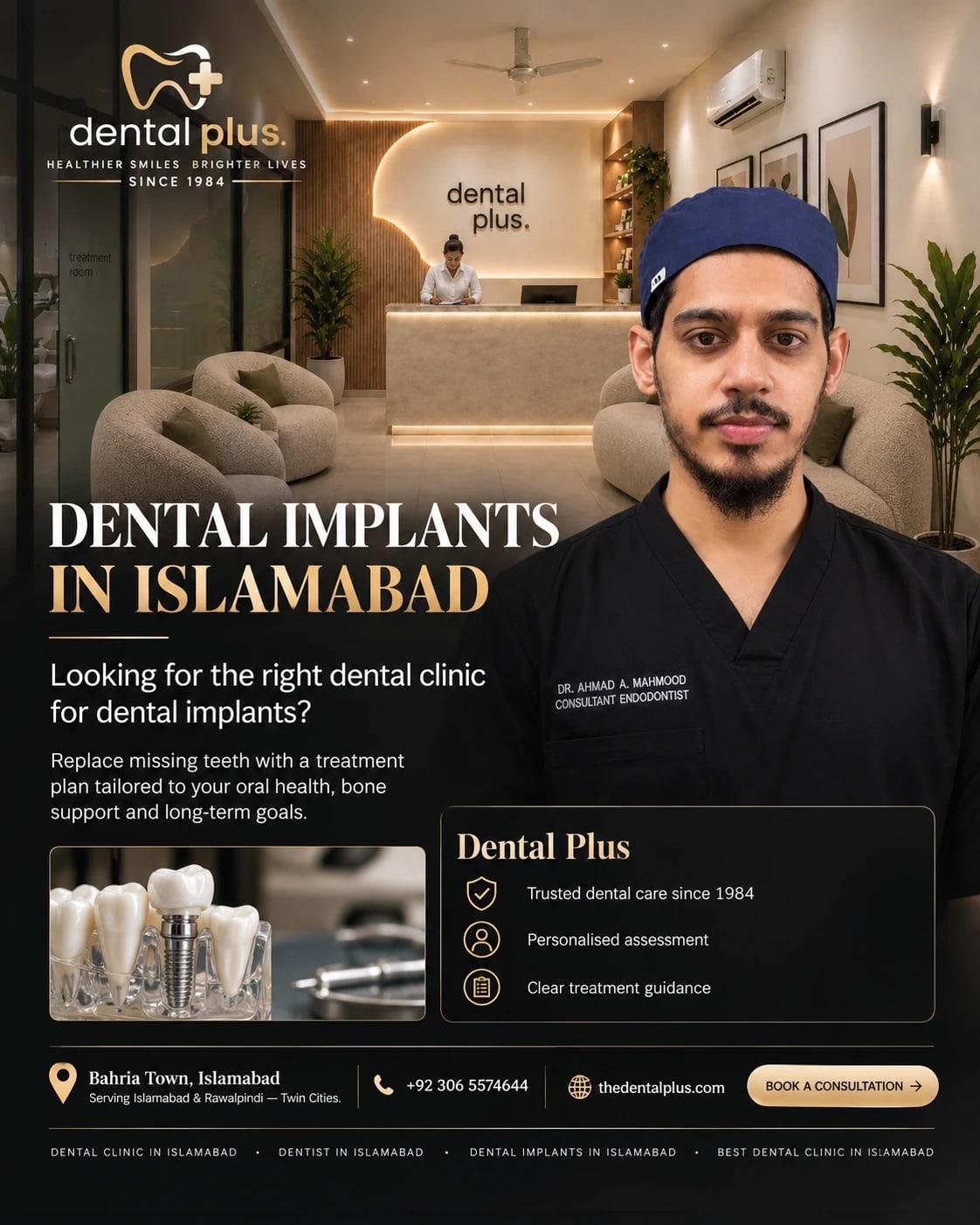
Implants at Dental Plus are placed by Dr Ahmad Mahmood, who holds a BDS, an MDS in Endodontics and Restorative Dentistry and C-Implantology training in implant surgery. Because his specialty is saving teeth, we first check whether your own tooth can be kept with a root canal. The crown is planned by our consultant prosthodontist, Dr Hafsa (BDS, FCPS), so it fits your bite. If you are still deciding, our guides on an implant or a bridge and on what implant surgery feels like answer the next questions people ask. Every step of dental implants in Islamabad at our clinic is set out on our main implant page.
Why patients across Islamabad choose Dental Plus for implants
In practice since 1984
Dental Plus has looked after patients for more than forty years, since Prof. Dr Amjad Mahmood opened it a year after qualifying.
An implant dentist with an MDS
Dr Ahmad Mahmood holds a postgraduate MDS plus C-Implantology training, and places our single-tooth implants himself.
A specialist for the crown
Consultant prosthodontist Dr Hafsa (FCPS) plans the crown so it fits your bite and matches your teeth.
Planned from your X-ray
We look at the bone, the nerve and the neighbouring teeth before recommending anything, and explain what we see.
Open 9 am to 11 pm, 7 days
Evening and Sunday appointments make it easier to keep the check-ups that keep an implant healthy.
At the centre of the twin cities
4-A Bahria Heights, 3 Extension, Phase 4, Bahria Town, Islamabad, a short drive from both Islamabad and Rawalpindi.
When to see a dentist
See a dentist if you have
- Gum around the implant that bleeds when you brush, or looks red and swollen
- A bad taste, pus or a bad smell coming from around the implant
- A crown that feels loose, rocks or clicks when you bite
- Pain or tenderness when you bite on the implant tooth
- Gum shrinking back so the metal starts to show
Get urgent help if
- Swelling of the face or jaw with a fever
- Swelling that spreads to your eye or neck, or makes it hard to breathe or swallow
How Dental Plus can help
Wondering whether an implant is worth it, or worried about one you already have? Book a consultation at Dental Plus, Bahria Town Phase 4, Islamabad. We're open 9 am to 11 pm, 7 days a week, and see patients from across Islamabad and Rawalpindi. Bring any X-rays you have. We'll check the gum and bone, tell you what we see and what it would take to keep your implant healthy, with no obligation to go ahead.
Common questions
How long do dental implants last on average?
In long-term studies, about 96% of implants were still in place after 10 years and 93% after 20 years. Many last the rest of a person's life. The crown on top usually needs repairing or replacing sooner than the implant.
Can dental implants last a lifetime?
Often, yes. An implant has no expiry date, but it isn't guaranteed either. It lasts longest in people who don't smoke, keep their gums healthy, control diabetes, protect it from grinding and keep their check-ups.
How often does the crown on an implant need replacing?
There is no fixed timetable. A 2018 review found about 98% of crowns on implants were still in use after five years, and about 3% had chipped. A worn or chipped crown can usually be replaced on the same implant without surgery.
What is the most common reason implants fail years later?
Peri-implantitis, an infection that destroys the bone around the implant. It starts as bleeding, swollen gum and often doesn't hurt at first, which is why check-ups matter even when nothing aches. Overload from grinding is the other main cause.
Can a failed dental implant be replaced?
Often, yes. The loose implant is removed and the area is left to heal, sometimes with a bone graft to rebuild lost bone, before a new implant is placed. An X-ray shows whether there is enough bone in your case.
Can I get an implant if I have diabetes?
Many people with diabetes have implants. What matters is how well it is controlled. Research has found more bone loss around implants as HbA1c rises, so we ask for your latest result and may suggest waiting until your sugar is better controlled.
Dental implant kitne saal chalta hai?
Sahi dekh bhaal ke saath implant kai saal, aksar zindagi bhar chalta hai. Research mein 20 saal baad bhi 93% implants apni jagah thay. Cigarette, masoorhon ki bimari aur be qaboo sugar se implant ki umar kam ho sakti hai.
Dental implant kitna safe hai?
Implant aik aam aur azmaya hua ilaaj hai, aur zyada tar implants kai saal tak theek kaam karte hain. Har surgery ki tarah is mein bhi kuch khatray hain, jaise infection. Is liye pehle X-ray aur check-up zaroori hai, taake dentist bata sake ke aap ke liye implant theek rahega ya nahi.
Sources
Checked on 23 November 2026. Every medical statement in this guide was checked against these sources; read our editorial policy. This guide is general information, not a diagnosis. If you are worried, see a dentist.
- Lupi SM et al. Dental implant survival and marginal bone loss after a minimum of 20 years. International Journal of Oral and Maxillofacial Surgery, 2026
- Kupka JR et al. How far can we go? A 20-year meta-analysis of dental implant survival rates. Clinical Oral Investigations, 2024
- Howe MS et al. Long-term (10-year) dental implant survival: a systematic review and sensitivity meta-analysis. Journal of Dentistry, 2019
- Pjetursson BE et al. Survival and complication rates of zirconia-ceramic and metal-ceramic single crowns. Clinical Oral Implants Research, 2018
- Reis INR et al. Prevalence of peri-implant mucositis and peri-implantitis based on the World Workshop criteria. Journal of Dentistry, 2025
- Fan YY et al. Smoking in relation to early dental implant failure: a systematic review and meta-analysis. Journal of Dentistry, 2024
- Stiller HL et al. The effects of smoking on dental implant failure: a current literature update. Dentistry Journal, 2024
- Serroni M et al. History of periodontitis as a risk factor for implant failure and incidence of peri-implantitis. Clinical Implant Dentistry and Related Research, 2024
- Lv X et al. Effects of diabetes/hyperglycemia on peri-implant biomarkers and clinical and radiographic outcomes. Clinical Oral Implants Research, 2022
- Häggman-Henrikson B et al. Bruxism and dental implants: a systematic review and meta-analysis. Journal of Oral Rehabilitation, 2024
- Lin CY et al. The effect of supportive care in preventing peri-implant diseases and implant loss. Clinical Oral Implants Research, 2019