Key points
- You are numbed before anything starts, so implant surgery itself should not be painful
- Soreness is usually worst around 24 hours after surgery and then fades
- Most people go back to work the next day and feel like themselves within about a week
- Swelling, a little bruising and blood-tinged saliva for a few days are normal side effects
- Worsening pain, fever, pus, a loose implant or numbness that does not wear off need a dentist
Is a dental implant painful? What the research says
Pain is the main worry for most people facing dental surgery, as a 2021 review in the International Journal of Dentistry points out, and it puts many people off replacing a missing tooth. In a study of 234 patients who had 510 implants placed, published in the Journal of Periodontology, pain was highest 24 hours after surgery and averaged about 2 out of 10. For most patients it stayed mild at every check, and only a few had moderate or severe pain. The same 2021 review went further: placing an implant was less unpleasant than having a tooth taken out, with less pain afterwards and less disruption to daily life.
You will still be sore for a few days, and your jaw may feel bruised. The pain follows a predictable pattern, though, and for most people ordinary painkillers are enough. Once you know what normal healing looks like, a twinge on day two is much less alarming.
What you feel during implant surgery, step by step
For a single tooth, placing the implant usually takes around half an hour, according to the British Association of Oral and Maxillofacial Surgeons. Here is what each stage feels like:
- The numbing injection: a brief sting or pinch, then your gum, lip and cheek go numb over a few minutes
- Opening the gum: you feel touch and movement, not pain
- Preparing the bone: vibration, pressure and a drilling sound. It can feel strange, but it should not hurt
- Placing the implant: firm pressure as the post is turned into the bone
- Stitches: a light tugging as the gum is closed over or around the implant
If anything feels sharp at any point, say so or raise your hand, and the dentist can stop and give more anaesthetic. Don't try to sit through it, because it matters for later too: in the Journal of Periodontology study, people who felt pain during surgery were more likely to still be sore after the first day.
Dental implant recovery: a day-by-day timeline
Everyone heals at their own pace, and a bone graft makes treatment more involved. For a straightforward single implant, this is the usual pattern, drawn from NHS hospital aftercare leaflets and Cleveland Clinic:
| When | What is normal | What helps |
|---|---|---|
| First few hours | Numb lip and cheek, a little oozing from the wound | Take your first painkillers before the numbness wears off. If it bleeds, bite on a rolled clean handkerchief for at least 30 minutes |
| First 24 hours | Soreness at its peak, blood-tinged saliva | Ice pack on the cheek for 10 minutes every hour for the first 6 hours. Soft food, no alcohol |
| Days 2 to 3 | Some swelling, sometimes a bruise on the cheek or jaw | Painkillers regularly for the first 48 hours. Gentle warm salt-water rinses from the day after surgery |
| Days 4 to 7 | Soreness clearly easing | Most people feel like themselves within about a week |
| Weeks 1 to 2 | Stitches loosening or dissolving | Stitches come out or are checked 7 to 14 days after surgery. Start brushing the implant area again after one week |
| Months 3 to 9 | Nothing you should feel: the bone is fusing with the implant | Look after your gums, and come to your check-ups |
| Crown fitting | A short visit, about an hour | A buried implant may need a small second procedure to uncover it first |
So, how long does dental implant pain last? For most people, the worst is in the first day or two, and Guy's and St Thomas' NHS Foundation Trust says discomfort should last no more than a week. If you still feel it after a week but it is fading, that is healing. If it is getting worse, or comes back after it had settled, get it checked.
Dental implant side effects: what is normal and what is not
Most dental implant side effects are part of normal healing and settle on their own. A few mean something needs attention. Here they are side by side, based on Cleveland Clinic and NHS guidance:
| Usually normal | Call your dentist | |
|---|---|---|
| Pain | Soreness that eases a little each day | Pain that gets worse after the first few days, or returns once settled |
| Swelling | Some swelling and bruising that settle over the week | Swelling that keeps growing, or swollen glands in your neck |
| Bleeding | Blood in your saliva for a few days | Bleeding that will not stop with firm pressure |
| Gums | Feeling the stitches with your tongue | Fever, pus or swollen gums around the implant |
| The implant | A dull ache when you touch the area | An implant that feels loose or moves |
| Numbness | Numbness for a few hours while the anaesthetic wears off | Numbness or tingling in the lip, chin or tongue the next day |
A simple rule: normal healing gets a little better each day. If a symptom is getting worse instead, call us rather than waiting for your next appointment. Uncontrolled bleeding is an emergency, so go to the nearest hospital emergency department if pressure doesn't stop it.
Less common side effects: nerves, infection, allergy and failure
These are rare, but it is better to know about them before treatment. Implants in the lower jaw sit near the nerve that gives feeling to the lip, chin and tongue. Cambridge University Hospitals NHS Trust says the nerve can be bruised, causing tingling or numbness, that it usually recovers within a few months and is rarely permanent. Your X-ray shows how much bone sits above that nerve, which is why we plan every implant from an X-ray. In the upper back jaw, the X-ray does the same job for the sinus, which can limit how much bone there is.
Infection is uncommon, especially when antibiotics are used, so if you are prescribed a course, finish it. True allergy is not something most people need to worry about: Cleveland Clinic describes titanium and ceramic implants as biocompatible, meaning the body accepts them, but do tell us about any metal allergy at the consultation. Occasionally an implant does not fuse with the bone. Leeds Teaching Hospitals NHS Trust says about 90% of implants placed 10 years ago are still in place and working.
The long-term side effect worth knowing about is peri-implantitis, a gum infection around an implant that can wear away the bone holding it. A 2025 review in the Journal of Dentistry found it around 18% of implants across the studies it pooled, but only about 5% of implants in non-smokers. Smoking matters for failure too: a 2021 analysis of 292 publications in Medicina found implants in smokers had around 2.4 times the odds of failing. Brushing, cleaning between your teeth and regular check-ups do most of the protecting.
What makes implant pain worse, and what makes it better
Some things you can't change. The Journal of Periodontology study found women were more likely than men to still be sore after the first day, and a bone graft makes treatment more involved. The strongest link in that study, though, was with the person holding the instruments: pain after the first 24 hours was far more likely when the implant was placed by a less experienced operator. Who places your implant affects how you feel afterwards. The things you can control are simple:
- Take painkillers on a schedule for the first 48 hours, starting before the anaesthetic wears off, as your dentist advises and as the pack says
- Use ice on the cheek in the first 6 hours, wrapped in a cloth and never directly on the skin
- Skip alcohol for at least 24 hours, and avoid smoking
- Leave the implant area alone: no brushing it for a week, no prodding with your tongue or finger
- Rinse gently with warm salt water from the day after, a flat teaspoon of salt in a cup of warm water
- Keep your follow-up visit, so the stitches and healing can be checked
If you smoke, the best thing you can do for both comfort and success is to stop before surgery and stay off cigarettes while the implant heals. Cleveland Clinic notes that smoking can disrupt healing, and it is the habit most clearly linked with implants that fail.
What to eat after a dental implant
Guy's and St Thomas' NHS Foundation Trust says you should be able to eat normally, though your dentist may suggest soft food at first. Soft food for the rest of the day of surgery is the easy choice, and chew on the other side for the first few days. Good options from an ordinary Pakistani kitchen:
- Dahi and raita
- Lukewarm daal, khichdi and soft rice
- Soups, kept warm rather than hot
- Scrambled or boiled eggs
- Mashed aloo and soft-cooked vegetables
- Kheer, custard and bananas
Wait until the numbness has completely gone before hot chai or anything you need to chew, because you can bite your cheek or burn your mouth without noticing. After the first few days most people go back to a normal diet, still chewing away from the implant until it has healed. Ask us before going back to very hard food, like nuts or bones, on that side.
Implant aftercare in Islamabad: why a central clinic helps
An implant is a few visits spread over months: the consultation, the surgery, a check of the stitches 7 to 14 days later, and the crown after the bone has healed. Aftercare is easier when the clinic is not a long drive away on a day when your face is swollen. Dental Plus is in Bahria Town Phase 4, on the Islamabad border at the centre of the twin cities, just off the Islamabad Expressway. From most of Islamabad it is a short drive:
- About 17 minutes from DHA Phase 2
- About 22 minutes from Saddar
- About 25 minutes from Gulberg Greens on the Islamabad Expressway
- About 45 minutes from F-7 and G-9
We're open 9 am to 11 pm, 7 days a week, Sundays included. If something feels wrong on the evening of your surgery, you can call or come in the same day, and you can have your stitches checked without taking a day off work.
How we keep implant surgery comfortable at Dental Plus
For every single-tooth implant, we:
- Examine you and take an X-ray first, so we know where the nerve, the sinus and the bone are before we begin
- Ask about your health, medicines and smoking, because they change how you heal
- Explain each step before it happens, so nothing in the chair comes as a surprise
- Check you are fully numb before we start, and stop if you feel anything sharp
- Go through aftercare before you leave, then check the healing at a follow-up visit
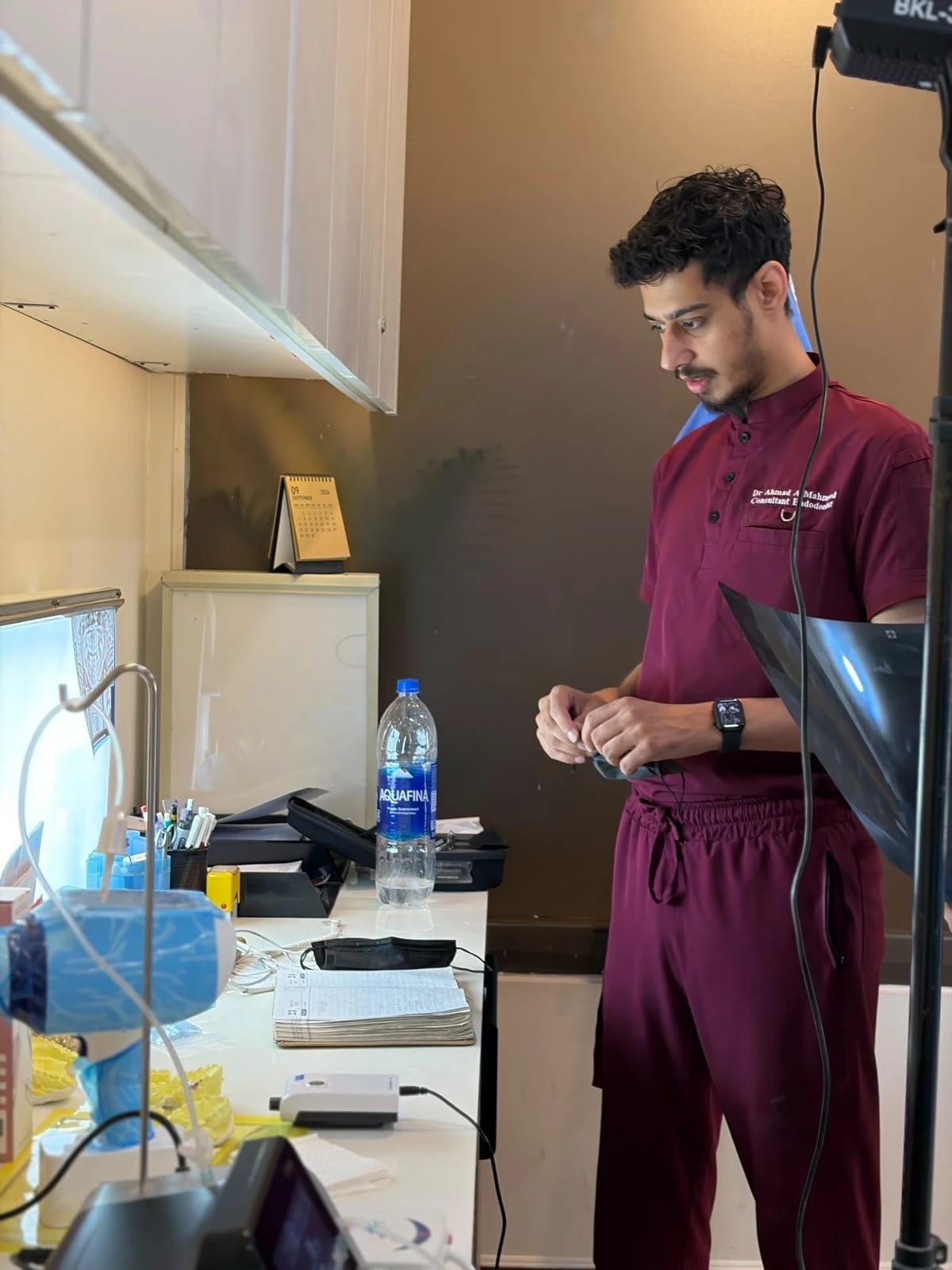
Implants at Dental Plus are placed by Dr Ahmad Mahmood, who holds a BDS, an MDS in Endodontics and Restorative Dentistry and C-Implantology training in implant surgery. Because his specialty is saving teeth, the first question is always whether your own tooth can be kept with a root canal. The crown on your implant is planned by our consultant prosthodontist, Dr Hafsa (BDS, FCPS). The clinic was founded in 1984 by Prof. Dr Amjad Mahmood, an orthodontist, Fellow of the Royal College of Surgeons of Edinburgh and two-term President of the Pakistan Association of Orthodontists. If teeth have drifted into your gap, our orthodontists can look at it within the same plan, as our implant or bridge guide explains. Every step of dental implants in Islamabad at our clinic is set out on our main implant page.
Why patients across Islamabad choose Dental Plus for implants
In practice since 1984
Dental Plus has treated patients for more than forty years, since Prof. Dr Amjad Mahmood opened it a year after qualifying.
An implant dentist with an MDS
Dr Ahmad Mahmood holds a postgraduate MDS plus C-Implantology training, and places our single-tooth implants himself.
A specialist for the crown
Consultant prosthodontist Dr Hafsa (FCPS) plans the crown so it fits your bite and matches your teeth.
Open 9 am to 11 pm, 7 days
Evening and Sunday appointments for surgery, stitch checks and any worry in between.
At the centre of the twin cities
4-A Bahria Heights, 3 Extension, Phase 4, Bahria Town, Islamabad: about 17 minutes from DHA Phase 2 and 22 from Saddar.
Planned from your X-ray
We look at the bone, the nerve and the neighbouring teeth before recommending anything, and explain what we see.
What patients say about treatment with Dr Ahmad
Dental Plus is rated 4.8 on Google from 131 reviews. These reviews mention how comfortable treatment felt. They are about root canals, scaling and fillings rather than implants, and we show them exactly as patients wrote them. Read every review on Google.
My mother got her root canal done from Dr. Ahmad. He did everything so proficiently and masterfully and exhibited the meticulous care. She witnessed an utter professional and painless treatment. It was a legit stupendous experience there. I would strongly recommend to visit and get yourself treated
I had an excellent experience with Dr. Ahmed Mahmood. I underwent scaling, polishing, and a dental filling, all of which were painless and comfortable. Dr. Ahmed has outstanding bedside manners, explaining each step clearly and helping me feel at ease. He is efficient without rushing and demonstrates great attention to detail. The clinic was clean and welcoming, with friendly, professional staff. It’s clear Dr. Ahmed cares about patient comfort and delivers high-quality care. I highly recommend Dr. Ahmed Mahmood for anyone seeking a skilled and trustworthy dentist. I’ll definitely return for future care.
I recently had my scaling done with Dr.Ahmad Abdullah Mahmood.The procedure was surprisingly pain-free. Moreover, the service provided was quite exceptional.The amalgamation of exalted aura of clinic and the professional mien of doctor made me feel at ease. It was a legit tremendous experience. I would highly recommend to visit and get your treatment done from there. Best clinic in Bahria Town, Islamabad!!
Very satisfied with the professional attitude and sensibility of my Endodontist here. RCT, Fillings and scaling all done pain free and upto the mark. Highly recommended!
When to see a dentist
See a dentist if you have
- Pain that is getting worse after the first few days, or comes back after it settled
- Fever, pus, a bad taste or swollen gums around the implant
- An implant or healing cap that feels loose
- Numbness or tingling in your lip, chin or tongue the day after surgery
Get urgent help if
- Bleeding that will not stop after 30 minutes of firm pressure
- Swelling that spreads to your eye or neck, or makes it hard to breathe or swallow
How Dental Plus can help
Worried about pain, or already sore after an implant done somewhere else? Book a consultation at Dental Plus, Bahria Town Phase 4, Islamabad. We're open 9 am to 11 pm, 7 days a week, and see patients from across Islamabad and Rawalpindi. Bring any X-rays you have. We'll tell you what the surgery involves for your tooth, how many visits it needs and what it costs, with no obligation to go ahead.
Common questions
Is a dental implant painful?
Not during the procedure, because the area is numbed with local anaesthetic first. You feel pressure and vibration. Afterwards most people are sore for a few days, worst at about 24 hours, and in one study of 234 patients the average pain at that point was about 2 out of 10.
How long does pain last after a dental implant?
Soreness is usually worst in the first 24 to 48 hours and eases over the rest of the week. Guy's and St Thomas' NHS Foundation Trust says discomfort should last no more than a week. Pain that grows after that needs checking.
Is an implant more painful than a tooth extraction?
Usually not. A 2021 review in the International Journal of Dentistry found implant placement less unpleasant than an extraction, with less pain afterwards and less disruption to daily life.
Can I go to work the day after a dental implant?
Most people can. Plan to rest for the rest of the day of surgery. If your job is physical or involves a lot of talking, a day or so at home can help.
Is swelling after a dental implant normal?
Yes. Some swelling, and sometimes a bruise, is common in the first few days and fades over the week. An ice pack in the first 6 hours helps. Swelling that keeps growing, or comes with fever or pus, is not normal.
What are the long-term side effects of dental implants?
The main one is peri-implantitis, a gum infection that can wear away the bone around an implant. It is much less common in non-smokers, and good cleaning and regular check-ups help prevent it.
What are the signs that a dental implant is failing?
An implant that feels loose, pain or swelling around it that gets worse, pus, bleeding gums or a fever. Contact your dentist straight away if you notice any of these.
Do front tooth implants hurt less than back tooth implants?
Not necessarily. How much healthy bone you have matters more than where the tooth is. Lower back teeth sit near a nerve and upper back teeth near the sinus, so those placements need careful planning. Your X-ray shows what applies to you.
Sources
Checked on 19 November 2026. Drafted with the help of AI writing tools, then every medical statement was checked against these sources; read our editorial policy. This guide is general information, not a diagnosis. If you are worried, see a dentist.
- Guy's and St Thomas' NHS Foundation Trust: After having a dental implant
- Guy's and St Thomas' NHS Foundation Trust: Having a dental implant
- British Association of Oral and Maxillofacial Surgeons: Insertion of a dental implant
- Cambridge University Hospitals NHS Trust: Insertion of dental implants
- Cleveland Clinic: Dental implants
- Leeds Teaching Hospitals NHS Trust: Dental implants
- Al-Khabbaz AK et al. Assessment of pain associated with the surgical placement of dental implants. Journal of Periodontology, 2007
- AlQutub AW. Pain experience after dental implant placement compared to tooth extraction. International Journal of Dentistry, 2021
- Mustapha AD, Salame Z, Chrcanovic BR. Smoking and dental implants: a systematic review and meta-analysis. Medicina, 2021
- Reis INR et al. The prevalence of peri-implant mucositis and peri-implantitis: a systematic review and meta-analysis. Journal of Dentistry, 2025